SEO Is Not Dying, But The Old Way Of Doing It Just Did
Your page still ranks number one on Google. Your traffic is still falling anyway. If that sounds familiar, you are not doing anything wrong. You are just playing a game that changed its rules while nobody was watching.
"The person on the other side of that search has a real problem they need solved. Build content that matches that and you will outlast every update that is coming."
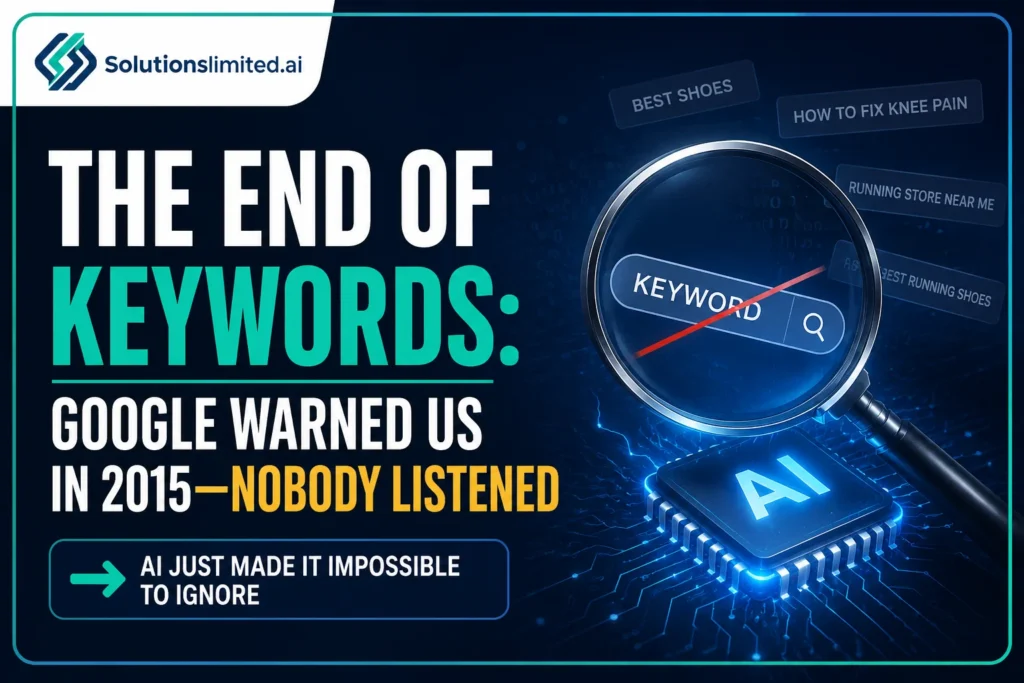
For twenty years, ranking high meant winning. Now a page can hold the top spot on Google and still lose the click. AI answers step in, give the user what they came for, and the visit never happens. This is not a small shift. It is the biggest change to search since Google itself launched, and it started with a warning most marketers never read.
What You Will Learn In This Post
- Why the keyword era was never really strategy
- The 2015 Google document that predicted all of this
- The numbers that prove search has changed for good
- How to write content AI actually wants to quote
- The 75 percent of AI answers that never come from your site
- Your action plan for this week
- Final thoughts
- Frequently asked questions
The Keyword Era Felt Like Skill. It Was Mostly Luck.
Ask any marketer with a few years of experience and they will tell you SEO used to be easier. It was not easier. We were just matching words, not understanding people. If someone searched for running shoes, you had no way of knowing if they were a new runner, someone nursing a knee injury, or a parent buying shoes for a kid. The keyword was a stand in for the real need, and honestly, it worked well enough that nobody questioned it.
Google was already trying to close that gap long before AI entered the picture. Featured snippets, People Also Ask boxes, zero click answers. Every one of these was Google reaching past the keyword and toward the actual moment a person was in. The crack was there for years. We just chose not to look at it.
Google Told Us This Exact Change Was Coming In 2015
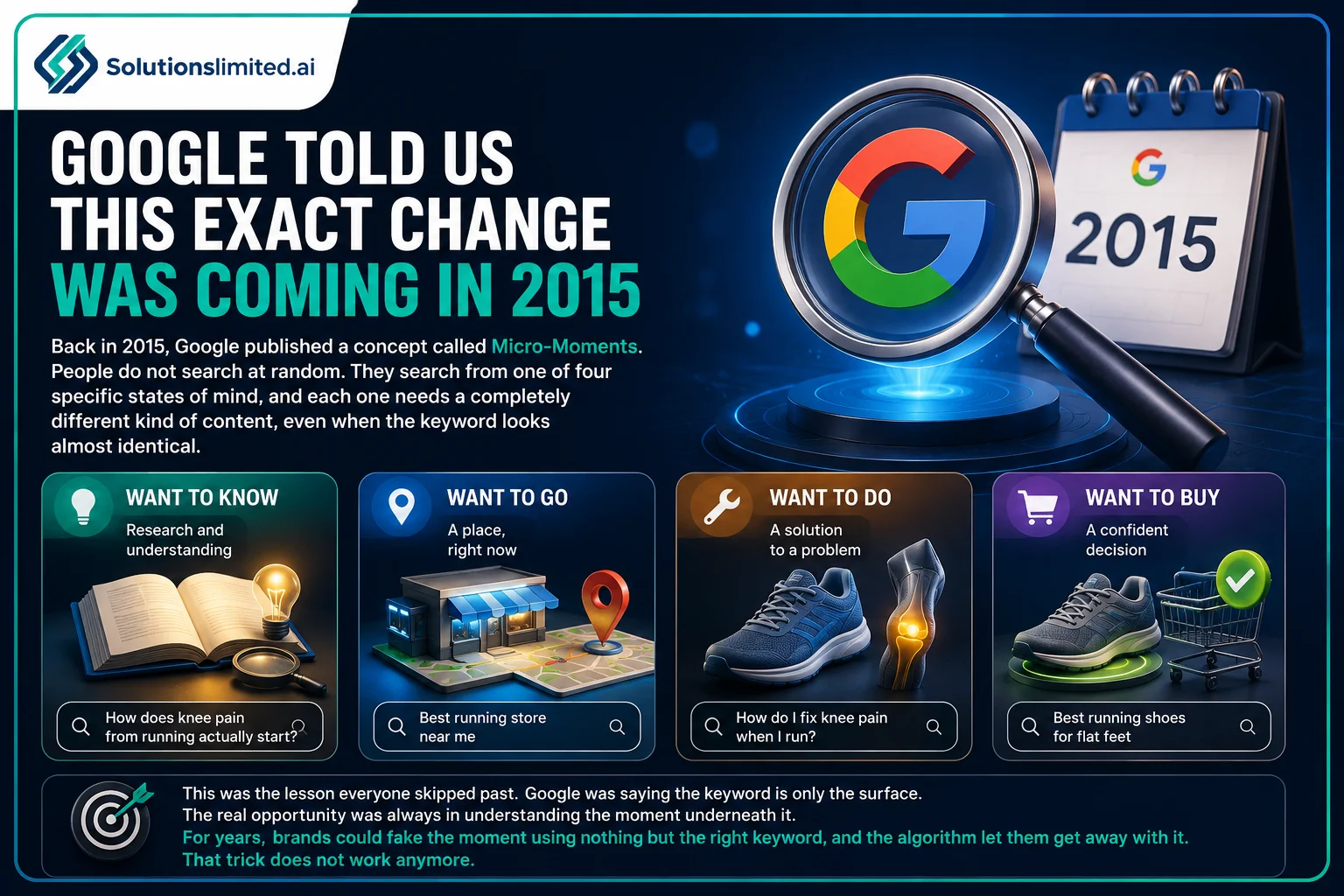
Back in 2015, Google published a concept called Micro-Moments. The idea was simple. People do not search at random. They search from one of four specific states of mind, and each one needs a completely different kind of content, even when the keyword looks almost identical.
| Moment | What The Person Wants | Example Search |
|---|---|---|
| Want To Know | Research and understanding | How does knee pain from running actually start? |
| Want To Go | A place, right now | Best running store near me |
| Want To Do | A solution to a problem | How do I fix knee pain when I run? |
| Want To Buy | A confident decision | Best running shoes for flat feet |
This was the lesson everyone skipped past. Google was saying the keyword is only the surface. The real opportunity was always in understanding the moment underneath it. For years, brands could fake the moment using nothing but the right keyword, and the algorithm let them get away with it. That trick does not work anymore.
The Numbers That Prove This Is Not A Trend, It Is Permanent
Nobody types keywords into an AI chat box. People describe a whole situation. A parent might type something like, my child has headaches every afternoon after using a tablet, what could be causing this. A business owner might ask why six months of Instagram posts brought likes but no walk in customers. These are not keywords. They are complete moments, and the data backs this up clearly.
| Metric | What The Data Shows |
|---|---|
| Search length and AI answers | Short searches of one to three words trigger an AI answer 23 percent of the time. Searches of six words or more trigger one 77 percent of the time. |
| People wanting conversational search | 76 percent of people now say they prefer describing their problem instead of typing keywords. |
| Click through rate for the number one result | Fell from 1.76 percent down to 0.61 percent once an AI answer appeared above it, a drop of more than 60 percent. |
| Ranking versus AI visibility | Ranking number one on Google gave only a 31.4 percent chance of appearing in the AI answer. By rank four, that chance dropped to 2.6 percent. |
| Where AI actually gets its answers from | 90 percent of pages AI cited were ranked 21 or lower on Google. AI only pulls 38 percent of citations from Google's top 10 results today, down from 76 percent. |
Your Google ranking and your AI visibility are now two separate scores. If your entire strategy is built around ranking alone, you are winning a game that matters less every month. This is exactly the kind of shift the team at Solutions Limited tracks closely, because search behavior does not wait for anyone to catch up.
How To Write Content AI Actually Wants To Quote
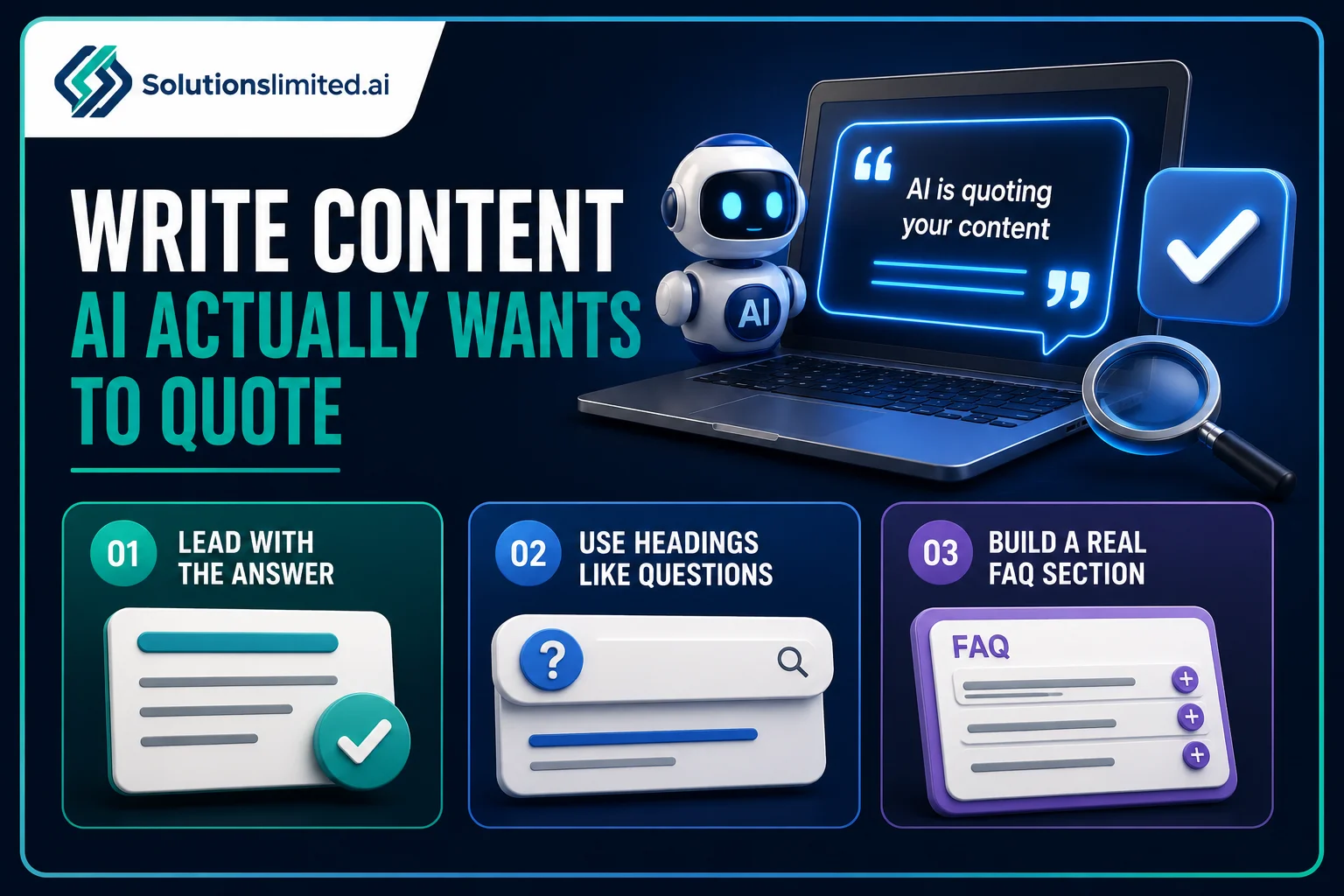
Getting cited by AI comes down to two separate questions. Can AI pull a clean, complete answer straight off your page? And does AI even find you in the places it already trusts? Most guides only answer the first one. Here is how to fix your own pages first.
Lead With The Answer, Not The Warm Up
Cut lines like "in this section we will explore." Nobody reads that, and neither does AI. Give the answer in the first sentence, then explain it.
Write Headings The Way People Actually Ask Questions
A heading like "what is the best moisturizer for acne prone skin under 100 dollars" matches what someone types into an AI tool at 11pm. Match the wording and you are already halfway to being the answer.
Build A Real FAQ Section
Write it in plain, natural language, not stiff keyword phrases. This one change alone tends to move citation rates more than months of technical SEO work. This is one of the core parts of the AEO and GEO services approach, because a good FAQ section is doing double duty for both readers and AI models.
The 75 Percent Game That Happens Away From Your Website
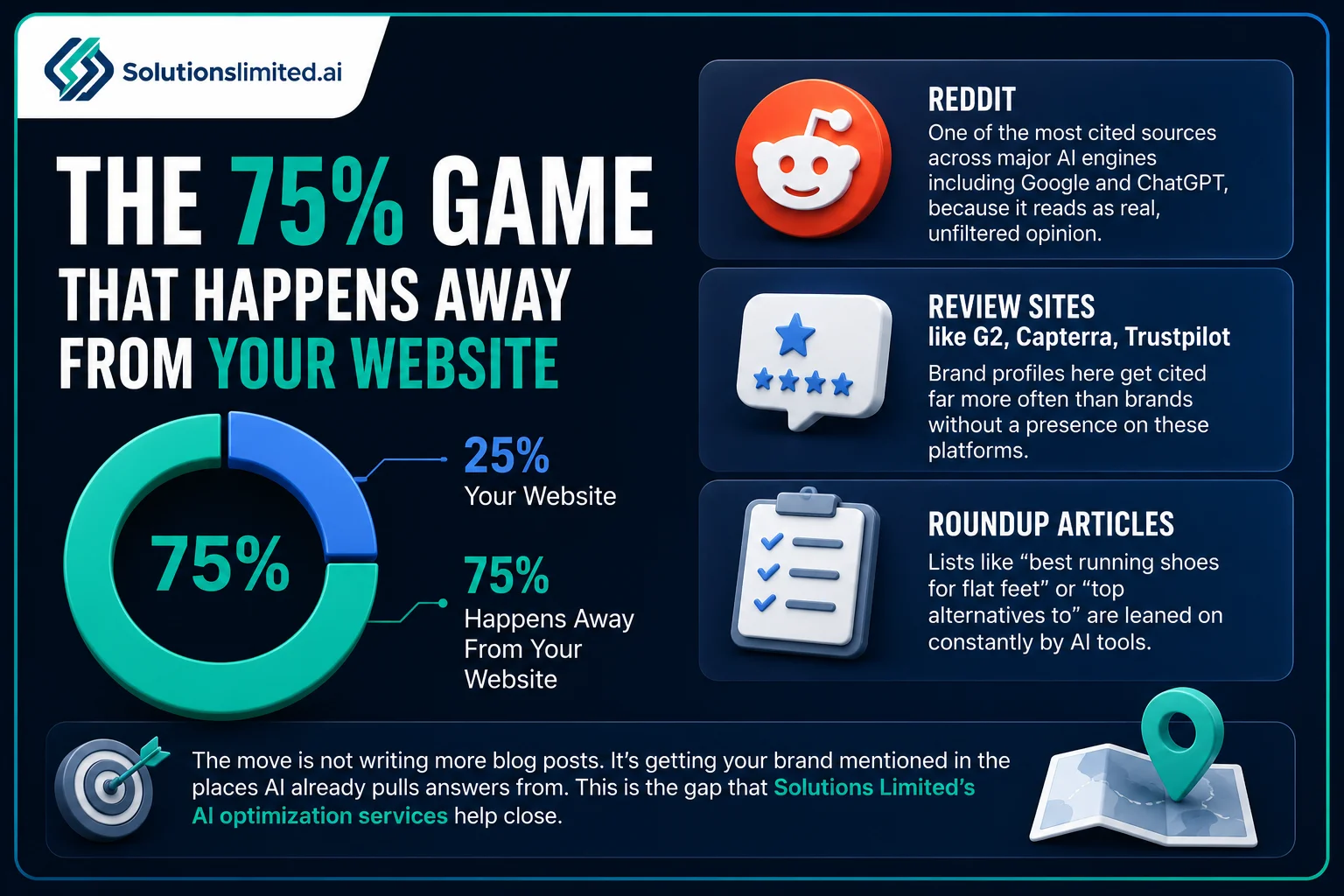
Here is the part most SEO advice skips entirely. Even when your own page is perfectly optimized, most of what AI cites still comes from somewhere else. That means winning your own page is maybe a quarter of the job. The other three quarters happen on pages you do not own, places AI already trusts.
| Source | Why AI Trusts It |
|---|---|
| One of the most cited sources across major AI engines including Google and ChatGPT, because it reads as real, unfiltered opinion. | |
| Review sites like G2, Capterra, Trustpilot | Brand profiles here get cited far more often than brands without a presence on these platforms. |
| Roundup articles | Lists like "best running shoes for flat feet" or "top alternatives to" are leaned on constantly by AI tools. |
The move here is not writing more blog posts. It is getting your brand mentioned in the places AI already pulls answers from. This is exactly the gap that Solutions Limited's AI optimization services help close, by mapping out where your competitors are already winning and building a real plan to get you listed there too.
Your Action Plan For This Week
You do not need a six month roadmap to start. You need one afternoon and a clear checklist.
| Step | What To Do |
|---|---|
| 1 | Pick your five highest traffic pages. |
| 2 | Search each page's core topic and find the top real questions people ask around it. |
| 3 | Pick three questions that match a "want to know" or "want to buy" moment. |
| 4 | Write a clean FAQ section at the bottom of each page answering those exact questions in plain language. |
| 5 | Check where your brand shows up outside your own website and start filling the gaps. |
Final Thoughts
Twenty years of Google updates, from Panda to Penguin to Helpful Content to AI Overviews, all moved toward the same target. Closer to what people actually needed, further from what marketers could fake. AI did not create this shift. It just closed the last gap Google had been pointing at since 2015.
If you have been building real content that answers real problems, you are not behind. You are ahead. You just need to reformat that content for the moment someone is actually in, and make sure AI can find your name in the places it already trusts. The businesses that started doing this early saw their AI driven leads jump from 3.1 percent to 7.4 percent in a single year. The window is still open. It just will not stay open forever.
Frequently Asked Questions
What is the difference between SEO and GEO?
SEO focuses on ranking your page in Google's list of links. GEO, short for Generative Engine Optimization, focuses on getting your content quoted directly inside AI answers like Google AI Overviews, ChatGPT or Gemini. A page can rank well on Google and still be completely ignored by AI, which is why both need separate attention now.
Why is my traffic dropping even though my Google ranking has not changed?
When an AI overview appears above your listing, it often answers the question directly, so people never click through. Data shows click through rate for the number one spot has dropped by more than 60 percent once an AI answer shows up above it. Your ranking stays the same, but the clicks disappear.
How do I get my content cited by ChatGPT or Google AI Overviews?
Lead with a direct answer instead of a long introduction, write your headings as real questions people would type, and build a genuine FAQ section in plain language. Beyond your own page, get your brand mentioned on Reddit, review platforms like G2 or Trustpilot, and relevant roundup articles, since most AI citations come from outside your own website.
Does ranking number one on Google guarantee I show up in AI answers?
No. Ranking number one only gives about a 31.4 percent chance of appearing in an AI answer, and that number drops sharply by rank four. In fact, most pages that AI actually cites rank 21 or lower on Google, which means your Google rank and your AI visibility are now two separate results.
What is a quick first step to improve my AI search visibility?
Start with your five highest traffic pages. Find the real questions people ask around each topic, pick three that match how a real person searches, and add a clean FAQ section answering them at the bottom of the page. This one change alone often improves citation rates faster than months of technical SEO work.