AI Search · 2026
Every year, someone says it again. SEO is dead. In 2026 the claim feels louder than ever. People ask ChatGPT instead of Google. AI hands back full answers in seconds. Fewer clicks reach websites. Google AI Overviews now show on roughly 30% of US desktop searches, and where they appear, organic click rates have fallen by about 61%. So it is easy to assume the old playbook is finished.
Here is the honest answer. SEO is not dead. The outdated kind is. Search did not vanish, it spread out. People still hunt for answers, services, and products. They just do it across more tools and platforms than ever. In 2026, winning search means being found wherever people look, and being clear enough that AI tools quote you. That is the whole story, and below is how to do it.
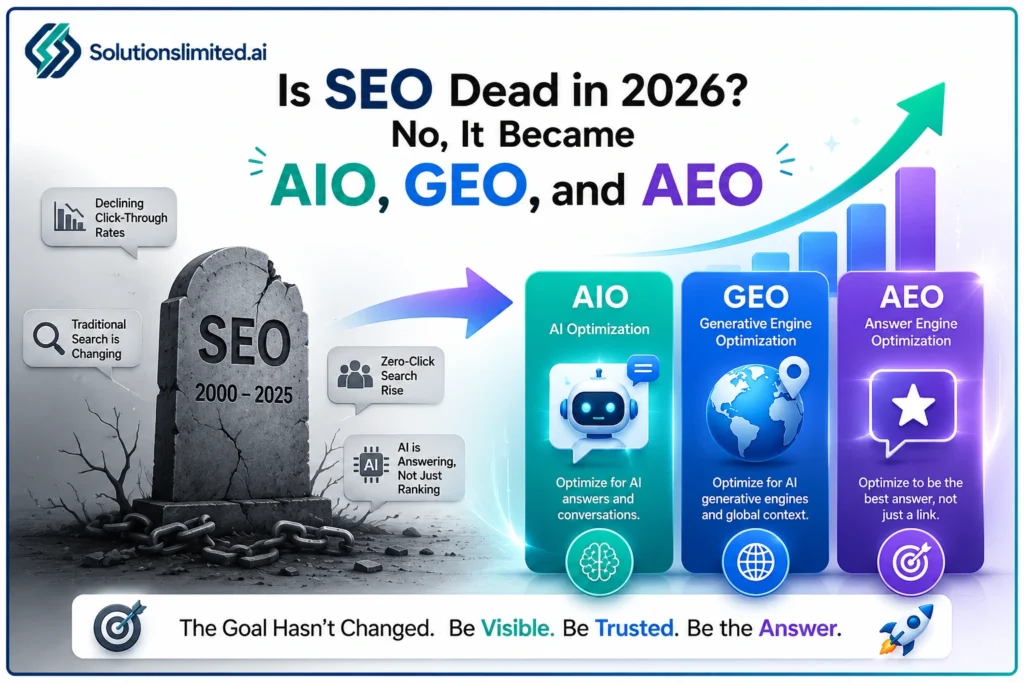
SEO did not die. It split into three. AIO, GEO, and AEO. And it now lives everywhere, not just on Google.
Why does everyone think SEO is dead?
The worry is not made up. Search behavior really is shifting, and the numbers are hard to ignore. People ask a question and get the answer right on the page, with no reason to click. That single change is shaking the whole industry.
Research firm Gartner predicts traditional search volume will fall by a quarter by 2026 as people shift to AI chatbots and answer engines. Clickstream data shows most Google searches now finish without a click. Pew Research found that when an AI summary sits on top, only a small share of users click through to a site. And the drop is not only about AI Overviews. Even on searches without one, organic click rates fell around 41% year over year, because people are getting answers from AI tools and social platforms before they ever reach Google.
Sources: Seer Interactive and Digital Time Savers reporting, 2025 to 2026.
So is SEO actually dead?
No. And the same data that scares people also proves it. Google still held close to 89% of US web traffic in 2025 and handles well over 15 billion searches a day. More than nine in ten online journeys still begin with a search. People have not stopped looking. They have added new places to look.
Here is the part most “SEO is dead” posts skip. AI search runs on the open web. Tools like ChatGPT, Gemini, and Perplexity pull from indexed, trusted pages, the same pages strong SEO has always built. AI driven search is still a small slice of total search volume, around 6%, but that figure roughly tripled in a single year, which is exactly why marketers are paying attention. The work that earned you rankings is the same work that earns you a mention inside an AI answer. SEO is now the fuel, not the finish line.
Generative AI tools are becoming substitute answer engines, replacing queries people once typed into search.
Alan Antin, Vice President Analyst, Gartner
Search did not shrink. It spread out.
This is the real shift. Search is no longer one channel called Google. It is a habit people carry across many apps. The new name for this is Search Everywhere Optimization. In plain terms, if someone looks for something anywhere, your brand should show up. You do not chase every platform at once. You treat search as a visibility strategy, not a single box.
Here is where people actually search in 2026, and why each one matters.
Still the foundation, with over 15 billion searches a day. But around 60% now end with no click, so being cited in AI Overviews matters as much as ranking.
ChatGPT alone handles about 2.5 billion prompts a day with roughly 800 million weekly users. Many treat it as a research and buying assistant.
Around 2.53 billion monthly users and the second biggest search engine. People search tutorials, reviews, and comparisons in video form.
Nearly 40% of Gen Z prefer them over Google for some searches, and 74% of Gen Z uses TikTok search. Captions and on-screen text count.
Reddit is now the single most cited source in AI answers, appearing in about 40% of them, ahead of Wikipedia and YouTube. People trust real talk.
Amazon and Walmart work like search engines for products. Clear titles, descriptions, and reviews decide whether you get found.
Meet the new search trio: AIO, GEO, and AEO
This is where classic SEO went. Three connected skills now sit on top of the basics. You do not pick one. You build all three together.
AIO: AI Optimization
AIO makes your site easy for AI models to read and trust. That means clean structure, strong entities, fast pages, and facts a machine can lift without confusion. If an AI crawler cannot parse your page cleanly, it cannot use you.
GEO: Generative Engine Optimization
GEO is the work of getting your brand named inside AI answers. When someone asks ChatGPT or Perplexity for the best option, GEO decides whether you appear in that reply. It leans on authority, clear takeaways, and content worth quoting. Page two does not exist in an AI answer. You are in it, or you are invisible.
AEO: Answer Engine Optimization
AEO is about winning the direct answer. Featured snippets, voice results, and AI Overviews reward content that answers the exact question fast and in plain words. Lead with the answer, then explain. Some people also call the AI side of this LLMO, large language model optimization, but the idea is the same. Clear, fact-rich content that machines can quote.
Old SEO vs new SEO, side by side
The fundamentals did not disappear. The scope grew. Here is the difference at a glance.
| Traditional SEO | Search Everywhere (SEO + AIO/GEO/AEO) | |
|---|---|---|
| Main goal | Rank on Google | Be found everywhere and cited by AI |
| Where | Google only | Google, AI tools, YouTube, social, marketplaces |
| Content style | Keyword-focused pages | Clear answers for people and machines |
| Success metric | Clicks and rankings | Citations, mentions, and branded search |
| Wins by | Backlinks and keywords | Authority, clarity, and real experience |
What really changed for businesses
The old goal was a click. The new goal is a citation. When an AI engine names your brand as a source, that mention builds trust before anyone visits your site. And the visits still come. Brands cited inside AI Overviews earn far more clicks than brands left out of the answer, and that AI-referred traffic tends to convert better because the user arrives already informed.
So the scoreboard moved too. Rankings still matter, but now you also watch whether AI tools mention you, whether you show up in featured snippets and People Also Ask, and how your branded search grows. Engagement signals like scroll depth and time on page now say more about quality than bounce rate ever did.
The technical and brand basics still matter
None of this works on shaky ground. AI engines and Google both reward a fast, clean, trustworthy site. Speed and stability are not optional. Google measures them with Core Web Vitals, and these are the targets to hit.
| Metric | What it measures | Goal |
|---|---|---|
| LCP | How fast the main content loads | 2.5 seconds or less |
| INP | How quickly the page reacts to a tap or click | 200 milliseconds or less |
| CLS | How much the layout jumps while loading | Under 0.1 |
Mobile comes first, since it drives more than half of web traffic. On top of speed, brand authority decides a lot. Google favors brands and entities it trusts, so branded search, reviews, and real mentions across the web lift you in both search and AI answers. This is the E-E-A-T idea, Experience, Expertise, Authoritativeness, and Trustworthiness. Show real experience, earn mentions from credible sources, and let happy customers speak through reviews and stories. Match search intent too, so the page gives the exact thing the searcher wanted in the first few seconds.
Common SEO mistakes in the AI era
Most brands that lose visibility make the same avoidable errors. Check yourself against this list.
- Chasing Google rankings only, while ignoring AI tools, YouTube, and social search.
- Publishing content with no plan to share it, so it never reaches the platforms that feed AI.
- Writing thin, generic, keyword-stuffed pages that AI and readers both skip.
- Never checking AI visibility, so you have no idea if ChatGPT or Gemini mention you.
- Treating SEO as a one-time task instead of an ongoing habit across channels.
How to stay visible on Google and AI in 2026
You do not throw away your SEO. You tighten it and add an AI layer. Here is where to focus.
- Answer first. Put the clear answer in the opening lines, then add the detail below it.
- Use question headings. Write your H2 and H3 tags as the real questions people ask AI tools.
- Add FAQs and key takeaways. Short Q and A blocks are easy for AI to lift and quote.
- Be everywhere your buyers search. Cover Google, AI tools, video, social, and marketplaces, not just your site.
- Build real authority. Show experience, publish original insights, and earn mentions across trusted sites.
- Keep the tech clean. Fast load, mobile first, proper schema, and crawlable pages so AI can read you fully.
- Track new metrics. Watch AI mentions, branded search, and engagement, not just rankings.
Do that and you cover every front at once. You rank on Google, you get cited by AI, you show up where buyers actually search, and you stay useful to the human reading it. If you want a hand, our AI SEO and GEO services are built for exactly this shift.
In the AI era, being the source beats being a link.
Frequently asked questions
No. SEO is changing, not dying. People still run tens of billions of searches a day, and Google still holds most of the market. What changed is the goal. You now optimize to rank on Google, to be cited inside AI answers, and to show up wherever people search.
SEO ranks your pages in search results. AIO makes your site easy for AI models to read and trust. GEO gets your brand named inside AI answers like ChatGPT and Perplexity. AEO wins the direct answer, such as featured snippets and AI Overviews. They work as one strategy.
It is the idea that search now happens across many platforms, not just Google. People search on ChatGPT, YouTube, TikTok, Reddit, and marketplaces like Amazon. Search Everywhere Optimization means making your brand visible in all of those places, wherever your buyers look.
Not soon. Google still handles the vast majority of searches and has added its own AI Overviews to keep users on the page. AI tools like ChatGPT are growing fast, so the smart move is to be visible on both, rather than bet on one.
Write clear, quotable content that answers real questions, back it with genuine expertise, and keep your site fast and well structured. Build authority through trusted mentions and reviews, and add FAQ and takeaway blocks AI can lift easily. A free audit is a good first step.
Be the answer, not an afterthought
Search is splitting across Google, AI tools, and social. We help your brand win on all of them, and stay clear and useful for the humans in between. See where you stand today.