AI Search & Content Strategy
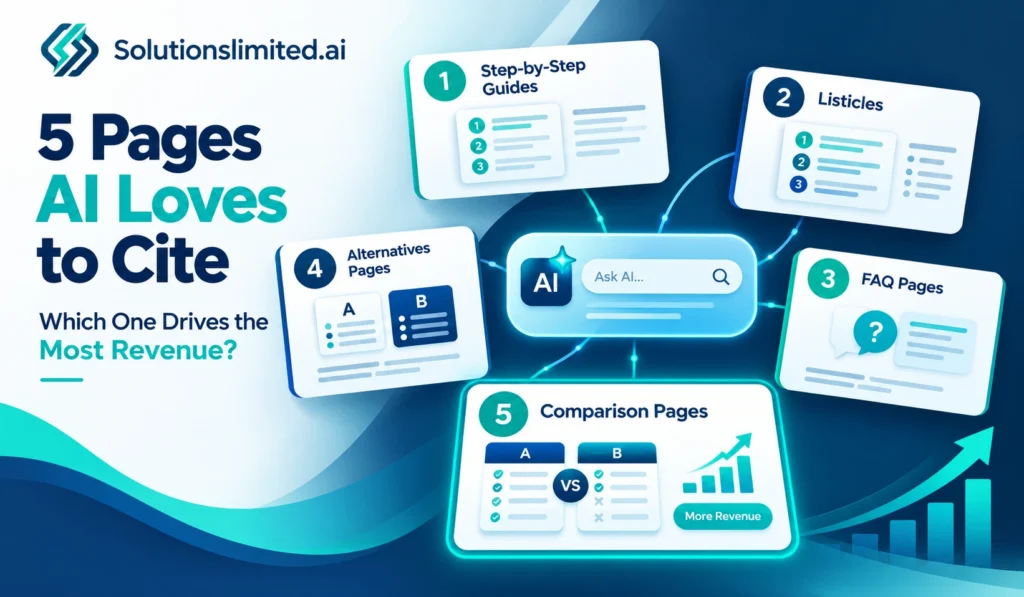
Ask ChatGPT, Gemini, or Perplexity a buying question and watch what happens. It pulls from a handful of page types again and again, and it mostly ignores the rest of your site. Five formats do most of the heavy lifting. Four of them get you mentioned. Only one tends to get you chosen.
This post walks through all five, what each one really does for your business, and how to build the one that matters most. If you are new to this side of search, our guide to Generative Engine Optimization (GEO) gives helpful background.
Table of Contents
AI cites many pages. It picks a winner from very few of them.
Getting Mentioned Is Not the Same as Getting Chosen
Most brands treat an AI citation like a win. It is a start, but a citation and a sale are two different things. When an AI tool pulls a fact from your guide, the reader gets the answer and often never visits your site. When it lists you as one of five options, the reader still has four other names to compare.
The pages that turn attention into revenue are the ones that help someone make a final decision. That is why it helps to sort your content by what each page type really does for you, not just by how often AI pulls from it.
| Page Type | What AI Does With It | Revenue Impact |
|---|---|---|
| Step-by-step guide | Pulls steps and facts from it | Low |
| Listicle | Ranks options, often names competitors too | Low to medium |
| FAQ page | Lifts short question and answer pairs | Medium |
| Alternatives page | Sends people toward you, not just a mention | High |
| Comparison page | Treats you as the source for a buying decision | Highest |
1. Step-by-Step Guides
AI tools love clear, ordered instructions. Do this, then that. The format is easy for a machine to read and easy to turn into an answer, so these pages get cited often.
The catch is that they rarely drive much revenue. The AI takes the steps and the reader moves on. That does not make guides useless. They build trust and topic authority, and they feed the rest of your content. Just do not expect them to close sales on their own.
How to write one well: use numbered headings, keep each step to one action, and add a short summary at the top. Our on-page SEO service covers this kind of structure in detail.
2. Listicles
AI likes ranked lists because they are easy to summarize. “Best tools for X” is a classic search, and a well-built list gets pulled into answers all the time.
Here is the problem. When an AI ranks options in order, it usually names several brands at once. If you are number two on someone else’s list, or number four on your own, the reader still sees your competitors right next to you. Being listed is not the same as being picked.
How to use them: treat listicles as a visibility tool. Be honest about your own ranking, give each option a clear reason for its place, and link readers to a deeper page where the real decision gets made.
3. FAQ Pages
One question, one short answer. That simple pattern is exactly what AI engines want to lift into a reply. A good FAQ page can boost your brand visibility and, because the answers come straight from you, it can support revenue too.
The trick is to answer the questions buyers actually ask, in plain words, right at the start of each answer. Skip the long warm-up. If the answer is two sentences, write two sentences. This is the heart of Answer Engine Optimization (AEO), and pairing your FAQs with proper schema through technical SEO makes them even easier for machines to read.
A mention gets you seen. A recommendation gets you paid.
4. Alternatives Pages
Someone searching for “alternatives to” a competitor is already unhappy or at least curious. That is a warm lead. If your page clearly explains how you are different, better, or cheaper, AI is more likely to send people to you instead of just naming you in passing.
Be specific. Vague claims like “we offer better service” give a machine nothing to quote. Real differences do: pricing, features, setup time, support hours, who the product suits best.
A quick rule: stay fair to the competitor. Pages that trash other brands read as biased, and both readers and AI tools tend to trust balanced pages more.
5. Comparison Pages
This is the one that earns its place at the top. A comparison page may not bring the biggest traffic numbers, and that surprises a lot of people. What it does is different. It lays out every meaningful difference between your product or service and the competition, side by side.
That matters because AI tools try to answer the question “which one should I buy?” A page that already does that comparison work, clearly and fairly, becomes the definitive source. It works the same way for B2B and B2C. Software, clinics, agencies, online shops: if buyers compare options before they choose, this page belongs in your plan.
How to Build a Comparison Page That Converts
Every good comparison page starts with the same thing: a “versus” search that a real person actually typed. Do not invent the matchup. Find one your customers already use, in their own words.
Find a real versus search
Use a tool like AnswerThePublic to see how people phrase comparison questions in your category. Match their wording in your title and headings.
Pick one matchup
One page, one comparison. Trying to cover five competitors in one page makes it messy for readers and for machines.
Put the answer up top
Give a short verdict in the first few lines, then a side-by-side table covering price, features, and who each option suits best.
Be honest about trade-offs
Say where the competitor is stronger. It makes the rest of your page more believable and more quotable.
Add a clear next step
Finish with one obvious action, like a free audit, a demo, or a quote request. This is the page where buyers are ready to act.
Keep the page fresh, too. Prices change and features get added, and outdated comparisons lose trust fast. If you have noticed content slipping over time, our post on why SEO traffic is dropping in 2026 explains a few reasons why.
The Real Takeaway
You do not need to drop any of these formats. Guides, listicles, and FAQs earn attention and build authority. Alternatives and comparison pages turn that attention into decisions. If you only have time to build one new page this month, make it a comparison page built around a real versus search.
Trust plays a big part in which brands AI recommends, and that is something worth building across your whole site. Our post on why reputation is now the foundation of marketing goes deeper on that.