AI Search & SEO
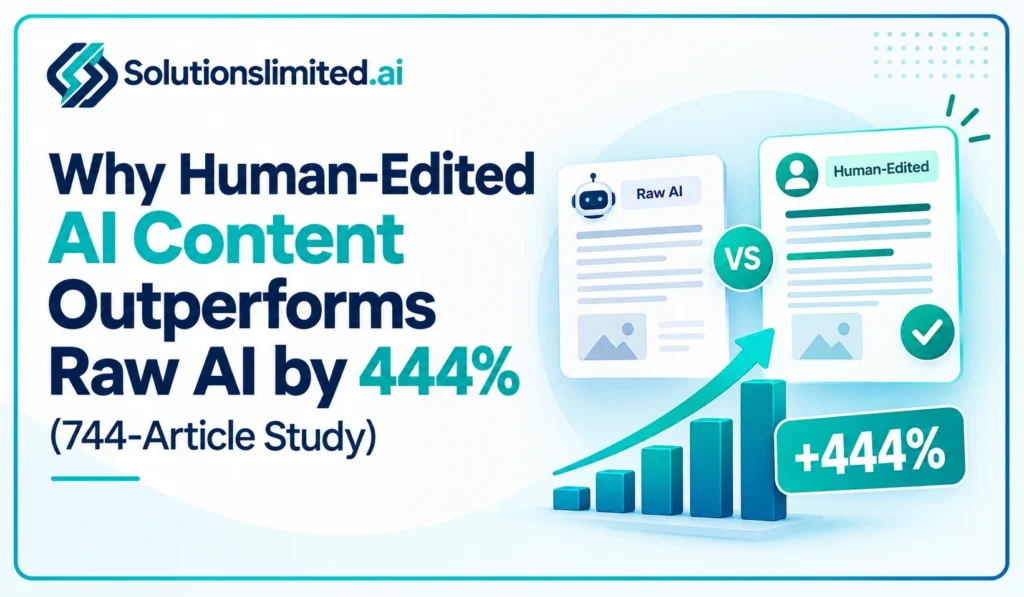
A large-scale test split AI-written articles into two groups. One group went live untouched. The other got one editing pass. The edited group pulled in 444% more traffic. Here’s what that pass actually looked like, and why Google can tell the difference even when your readers can’t.
Every business owner using AI to write content is running the same quiet experiment: hit publish and hope. Most never find out whether it worked, because there’s no control group to compare against. One recent study built that control group on purpose, and the results explain a pattern a lot of site owners have been noticing without understanding why. If you want to know where your own site currently stands, a free SEO audit is a fast way to check.
Table of Contents
“The human-edited group didn’t win by a small margin. It earned 5.44 times the traffic of the raw AI group, a 444% lift from a single editing pass.”
Your Readers Can’t Spot AI Content. Google Doesn’t Have That Problem
Reader tests keep landing in the same place: when you show people a mix of AI-written and human-written articles, most can’t reliably tell the two apart. That’s exactly why so many businesses feel comfortable publishing machine-written pages straight off the assembly line.
But there’s a second reader in the room, and it doesn’t need to guess. Several major AI platforms, including the tools most businesses use to generate content, embed invisible watermarking technology into their output. It’s a way to mark content as machine-generated at the source, and it’s built into the ecosystem that search engines and platforms already have access to. This is part of why AI Optimization (AIO) has become its own discipline instead of just an extension of regular SEO.
In other words, the question was never really “can people tell.” It’s “does the algorithm know.” And increasingly, it does.
Inside the 744-Article Test
Most opinions about AI content come from small, informal experiments or pure gut feeling. This one was different in scale: 744 articles, published across 68 real client websites in different industries, targeting comparable keywords and difficulty levels. Half went live exactly as the AI generated them. The other half got one human editing pass before publishing. That editing pass was the single variable being tested.
| Group | Process | Traffic Result |
|---|---|---|
| Raw AI | Published exactly as generated | Baseline |
| Human-Edited AI | One editing pass before publishing | +444% traffic |
What makes the finding more useful than a one-time snapshot is what happened after publishing. The gap between the two groups didn’t stay flat. It grew over time. Raw AI content tends to lose ground, while edited content tends to build on itself. This lines up with what we’ve seen on our own SEO traffic-drop research, where thin, unmaintained content is one of the first things to lose ground.
There’s evidence for why. During a Google spam update tracked in earlier research, sites running pure AI content lost around 17% of their organic traffic. Sites running human-edited AI content lost about 6%, on the same update, the same day. One-third the damage from the same event.
Separate research into repeated AI-generation passes points to a mechanical reason: when the same content gets passed through a language model over and over without a human layer, small errors and repeated phrasing stack up, and each version drifts a little further from anything distinctive. Left alone, AI content behaves less like a fixed asset and more like a car driving off the lot. Worth the most on publish day, and a little less every day after.
The Market Has Already Priced This In
A separate analysis of 100 companies looked at how much AI content gets published versus how much traffic it actually earns. The split is stark.
| Content Type | Share of Content Published | Share of Organic Traffic Earned |
|---|---|---|
| Raw AI content | 52.1% | 4.9% |
| AI content, lightly modified by a human | 27.4% | 8.1% |
| Human-written, human-ranked content | 14.5% | 87% |
Half the new content going onto the internet right now is AI-written, and it’s competing for roughly a twentieth of the available traffic. A light touch-up barely moves the needle either. Across this data, AI content rarely accounts for more than about 10% of a site’s organic traffic, no matter how much of it gets published.
A related study tracking 220 websites that leaned heavily into AI publishing found similar damage: 54% of those sites lost 30% or more of their peak organic traffic, 39% lost half, and 22% lost three quarters. Some ended up worse off than before they started publishing AI content at all.
The pattern holds on social platforms too. Human-made posts earn roughly double the likes and triple the saves of AI-generated posts, and lightly editing an AI post doesn’t close that gap much. Several platforms now label AI-generated content directly, and on LinkedIn, posts flagged as AI-assisted get shown to a narrower audience than original posts. Our social media marketing team runs into this exact gap when brands try to shortcut content with pure AI posts.
Google Says There’s No AI Penalty. Both Things Are True at Once
Google’s public position is that it does not penalize content for being AI-generated, and a large-scale study of 600,000 pages found no direct correlation between AI usage and ranking position. That’s accurate. It’s also not the full picture, because a ranking penalty was never really the mechanism doing the damage.
Search engines aren’t scanning for AI and docking points. They’re asking an older question: who said this, and can it be trusted?
The trust signals that AI search tools consistently reward are things like expert authorship, third-party citations, brand mentions, firsthand experience, and original data. This is exactly the ground covered by Generative Engine Optimization (GEO) and Answer Engine Optimization (AEO), which both focus on making a brand citable rather than just crawlable. Raw AI output, by definition, is a statistical blend of everything already published on a topic. It has no firsthand experience, no original data, and no accountable author attached to it. Content like that rarely earns citations, penalty or not.
That’s why the two findings sit next to each other without contradicting: there’s no ranking penalty for AI-generated content, and raw AI content still earns a fraction of the traffic per piece. One measures position. The other measures outcome. Strong technical SEO gets a page indexed. Trust is what gets it cited.
The 20-Minute Layer That Produced the 444% Lift
The editing pass that made the difference wasn’t a spellcheck and a rewritten intro line. It was five specific moves, and each one takes real time to do properly, usually 20 minutes at minimum, sometimes closer to an hour for longer pieces.
Add firsthand experience
A real client story, a number pulled from your own dashboard, something that proves a person who actually did the work touched the page.
Add something AI couldn’t know
Proprietary data or a specific example from your own business. If the same paragraph could sit on any competitor’s site, it isn’t earning its place.
Cut the filler
Delete the hedging and stock phrases AI tends to lean on, and tighten every claim so it says something specific.
Fact-check and refresh
Freshness is one of the strongest citation factors tracked across AI search platforms. Update the numbers, fix the dead links, make sure it reflects the current picture. Our on-page SEO checklist covers this in more depth.
Put a real author on it
A name and credentials attached to the piece, someone who’s accountable for the claims it makes. This is the same principle we cover in why reputation is now the foundation of marketing.
Worth noting: this layer is built for search. It doesn’t carry over to social, where audiences respond to content that feels made by a person from the start, not touched up after. For social, the better split is to let AI handle research and ideation while a person writes the actual post.
The Real Takeaway
None of this is an argument against using AI. It’s an argument against letting it publish unsupervised. Twenty minutes of focused editing turned into a 444% traffic lift in this test, which makes it one of the better returns available in marketing right now. The businesses losing ground aren’t the ones using AI. They’re the ones skipping the human layer that makes the content worth citing in the first place.