| Topic | Reputation engineering as the new foundation of digital marketing |
| Why it matters | AI platforms now generate a “verdict” about your business from everything published about you online |
| Core framework | 6 connected components: content, website, expertise, case studies, reviews, research |
| Best for | Businesses wanting long-term visibility across Google, AI Overviews, and generative engines like ChatGPT, Gemini & Perplexity |
| Related services | GEO, AEO, AI Optimization (AIO) |
For years, marketers optimized for platforms. Rank on Google. Win the ad auction. Get featured in the algorithm. But something has shifted underneath all of that.
Search, ads, and discovery are no longer the foundation. They’re just the surface. Underneath them sits one layer that quietly decides whether machines understand your business, trust it, and choose to put it in front of people: reputation.
This isn’t about reviews alone, or PR, or brand awareness in the old sense. It’s about something more specific and more mechanical — whether the sum of everything ever published about your business adds up to a clear, verifiable answer when an AI system is asked “who is this company, and can I trust them?”
What “Reputation as Infrastructure” Actually Means
Think about what happens now when someone searches for a business, a service, or an answer to a question. Increasingly, they’re not sifting through ten blue links. They’re getting a summary — an AI Overview, a chat answer, a generated recommendation. That summary is, in effect, a verdict.
The companies writing that verdict aren’t reading your ad copy. They’re reading everything: your website, your case studies, your reviews, your press mentions, your research, the credentials of the people behind your brand. Reputation is what they synthesize from all of it.
That’s why betting everything on one platform or one content format is a fragile strategy. Platforms change their algorithms. Formats fall out of favor. Reputation, if it’s built properly, travels across all of them and keeps compounding.
The Six-Part Reputation System
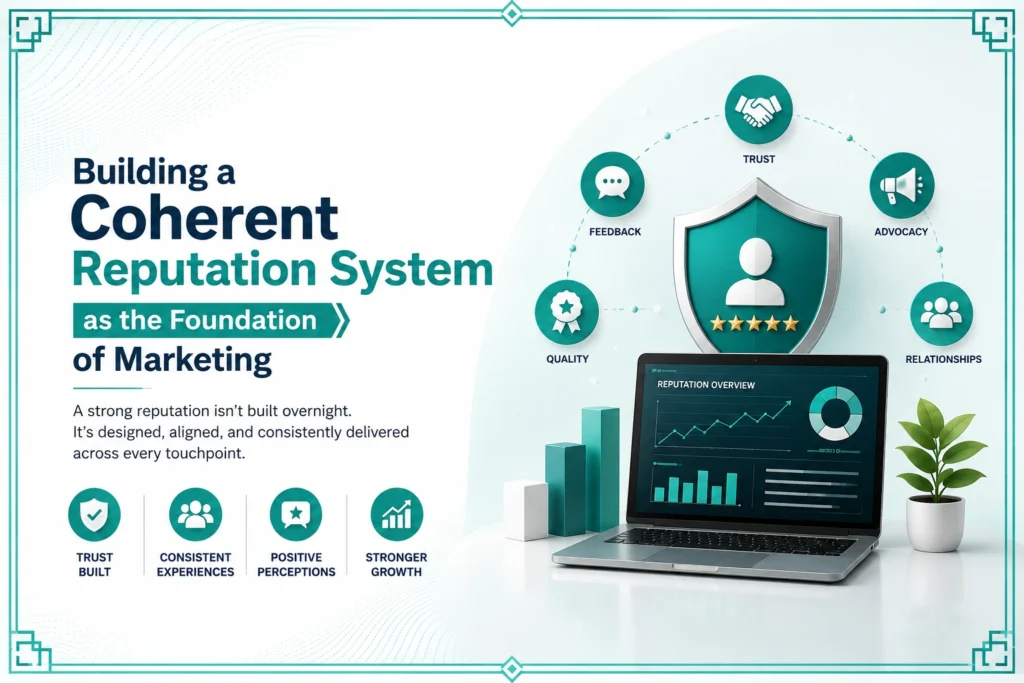
Building a reputation that machines can verify — not just guess at — comes down to six connected pieces.
The 6-Part Reputation Engineering Framework
Content
Establishes what you believe and know
Website
Says exactly who you are, clearly
Real Names
Attaches real expertise to your brand
Case Studies
Documents proof of real work done
Reviews
Proves the real customer experience
Original Research
Gives others a reason to cite you
| Component | Purpose | What It Signals to AI |
|---|---|---|
| Content | Declares core values and expertise | Defines your authoritative voice |
| Website | Official, clear online identity | Confirms who you actually are |
| Real Names | Verified personal credentials | Builds authenticity and trust |
| Case Studies | Proof of practical results | Validates your claims with evidence |
| Reviews | Third-party testimonials | Social proof that strengthens credibility |
| Original Research | New knowledge others reference | Generates citations that raise authority |
1. Content That Establishes What You Believe
Before anything else, your content needs to say something. Not generic filler, but a clear point of view on your industry, your approach, and the problems you solve. This is what tells both readers and algorithms what you actually stand for.
2. A Website That Says Exactly Who You Are
Your website is the hub every other signal points back to. It needs to answer, without ambiguity, who you are, what you do, and who you do it for — in language a machine can parse as easily as a human can.
3. Real Names Attached to Real Expertise
Anonymous content is invisible to trust systems. When actual people — with real credentials, real track records, and a real presence — are attached to your work, it becomes something a machine can verify instead of just index.
4. Case Studies That Document What You’ve Done
Claims are cheap. Documented outcomes aren’t. Case studies convert “we’re good at this” into “here’s exactly what we did, and here’s what happened.”
5. Reviews That Prove the Experience
Reviews are the closest thing to a live audit of your business. They’re written by people with no reason to inflate the truth, which is exactly why algorithms weight them so heavily.
6. Original Research That Gives Others a Reason to Cite You
This is the piece most businesses skip — and it’s arguably the most powerful. Third-party citations are one of the strongest signals across the AI platforms tested so far. Original research and data give other sites, journalists, and AI systems an actual reason to link back to you, which builds authority no amount of self-promotion can replicate.
Why This Beats Betting on Platforms or Formats
Platforms change. Formats die. A strategy built entirely around “rank on Google” or “go viral on one channel” is a strategy with an expiration date.
Reputation doesn’t work that way. It’s not owned by any single platform — it’s assembled from everything published about you, everywhere, over time. When a machine looks at the full picture and generates its verdict, a short summary that decides whether you get recommended or overlooked, the businesses that engineered that picture deliberately will consistently outperform the ones that left it to chance.
That’s the shift. Marketing isn’t just about being found anymore. It’s about being understood, verified, and trusted by the systems doing the recommending.
Frequently Asked Questions
It means reputation now functions as the foundational layer beneath search, ads, and content discovery. AI systems assess a business’s overall reputation across the web before deciding whether to recommend, cite, or trust it.
Traditional reputation management focused on public perception and PR. This approach focuses on making that reputation legible and verifiable to AI systems specifically — through structured content, real attribution, documented proof, and citable research.
Independent citations act as external validation. When other credible sources reference your business or research, it signals to AI platforms that your authority is real, not self-claimed.
Start with what’s missing. Most businesses already have a website and some content. The biggest gaps are usually real-name expertise, documented case studies, and original research — these build trust fastest.
It’s ongoing rather than a one-time project. Content, case studies, and research compound over months, not days. The businesses that start early build a lead that’s hard to close later.
Ready to engineer a reputation AI platforms can actually trust?
Solutions Limited AI helps businesses build coherent, verifiable reputation systems for the AI search era.