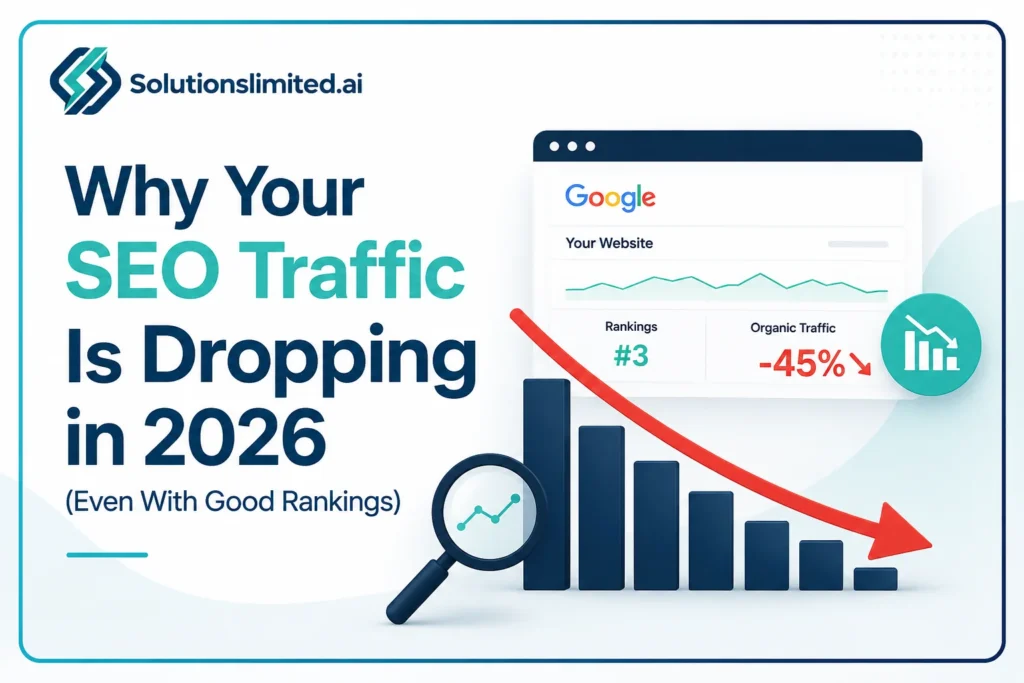
You check Search Console. Your rankings are fine. Some pages even moved up. But your actual visitors keep going down.
If that sounds familiar, you are not imagining it and you did not do anything wrong. Something bigger has changed in how people search, and it is hitting good websites just as hard as weak ones. Maybe harder.
Here is what is actually going on, why your best content is often the most exposed, and what small businesses can do about it that does not involve waiting for Google to change its mind. If you have not already, it is worth reading why so many businesses are doing SEO wrong for how people search now, since it sets up a lot of what follows here.
Your rankings are not lying to you. Your traffic reports are just measuring something different now.
Why Rankings No Longer Equal Traffic
For years, the deal was simple. Rank on page one, get clicks. That deal is breaking down.
A large share of searches today get answered before anyone reaches your website. AI Overviews, quick answer boxes, and other on-page search features now hand people a finished answer right on the results page. No click needed.
This is usually called a zero-click search, and it is not a small trend anymore. It is quickly becoming the normal way a lot of people search, especially for simple questions.
So a page can hold the exact same position it held a year ago and still bring in far fewer visitors, because fewer people ever needed to leave the search page in the first place.
The Kind Of Content Losing The Most
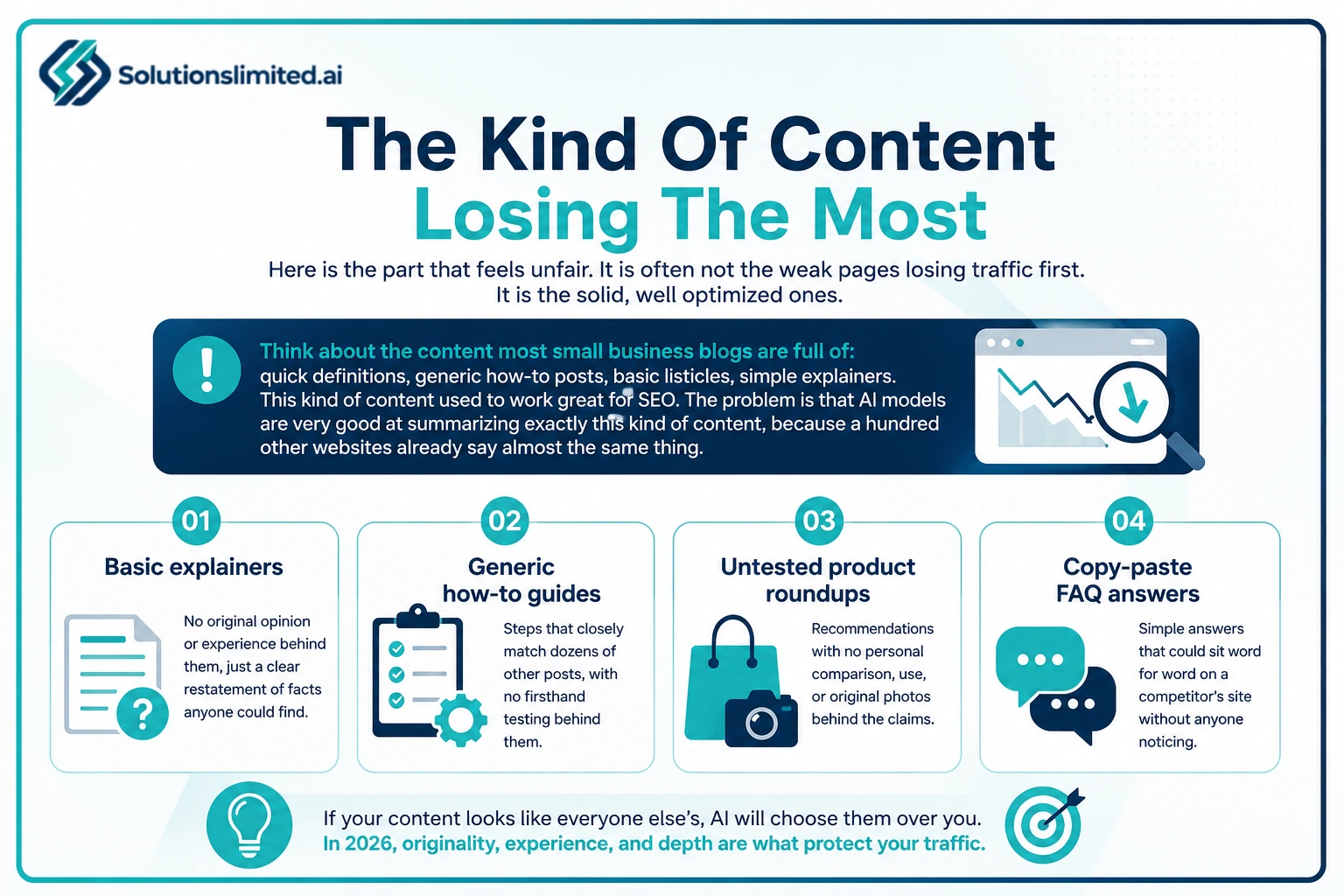
Here is the part that feels unfair. It is often not the weak pages losing traffic first. It is the solid, well optimized ones.
Think about the content most small business blogs are full of: quick definitions, generic how-to posts, basic listicles, simple explainers. This kind of content used to work great for SEO. The problem is that AI models are very good at summarizing exactly this kind of content, because a hundred other websites already say almost the same thing.
This is a separate issue from technical problems that can also be quietly costing you visibility, like the verification screens that can hurt your Google rankings. Even flawless technical SEO cannot save content that has nothing original left to say.
Basic explainers
No original opinion or experience behind them, just a clear restatement of facts anyone could find.
Generic how-to guides
Steps that closely match dozens of other posts, with no firsthand testing behind them.
Untested product roundups
Recommendations with no personal comparison, use, or original photos behind the claims.
Copy-paste FAQ answers
Simple answers that could sit word for word on a competitor's site without anyone noticing.
If an AI system can answer the question using ten other websites, it does not need to send anyone to yours, even if yours is well written.
None of this means the content was bad. It means it was replaceable.What Bigger Brands Are Quietly Doing About It
Several large publishers and well known content sites have openly said their search traffic has dropped sharply over the past year or two, in some cases by a lot. Scoop Rush has a detailed breakdown of this Google traffic collapse and the publishers most affected by it. What is more interesting than the drop is what they are doing in response, and it is rarely "wait for Google to fix it."
We covered the bigger picture behind this shift in Is SEO Dead in 2026? No, It Became AIO, GEO, and AEO, if you want the fuller context on why this is happening industry-wide and not just to a handful of sites.
The pattern shows up again and again. Companies that depended heavily on generic, broad, top-of-funnel content are shifting weight toward things a search engine cannot easily copy or summarize.
Direct relationships
Building email lists and newsletters that reach people without depending on a search click.
Video content
A format that resists being reduced to a short text answer inside a search results page.
Brand name searches
Encouraging people to search for the business directly instead of a generic industry term.
Fewer, deeper posts
Publishing less content overall, but built on real experience or original data.
The common thread is simple. A business built only on being found is fragile. A business people already recognize and actively look for is a lot harder to replace with an AI summary.
What Still Works, And Works Well
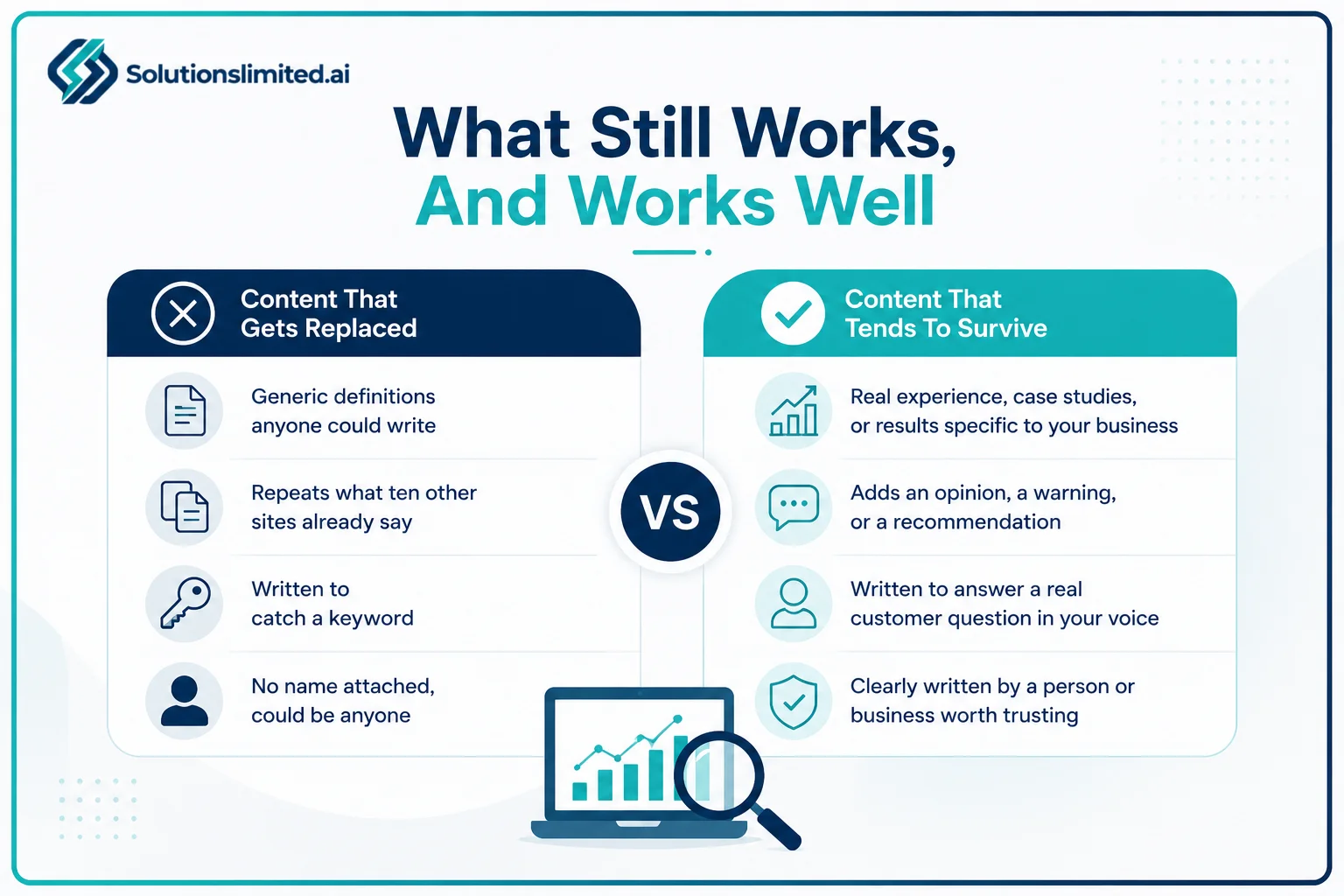
None of this means SEO is finished. It means lazy SEO is finished.
Search still matters a great deal for anything transactional or local. Someone looking for a dentist nearby, a caterer for an event, or a specific service in their city still needs to compare real options and take a real action. That kind of search is much harder to fully answer inside a summary box, which is exactly why local and service based businesses still have strong ground to stand on.
| Content that gets replaced | Content that tends to survive |
|---|---|
| Generic definitions anyone could write | Real experience, case studies, or results specific to your business |
| Repeats what ten other sites already say | Adds an opinion, a warning, or a recommendation |
| Written to catch a keyword | Written to answer a real customer question in your voice |
| No name attached, could be anyone | Clearly written by a person or business worth trusting |
This is exactly where answer engine optimization and generative engine optimization come in. Not a replacement for SEO, but what SEO needs to grow into.
The Metrics You Should Actually Be Watching
If total sessions is still the only number you check, it is time to add a few more to the list. Not every visitor is worth the same amount to your business, and the old numbers do not tell you which ones matter.
A thousand visitors who read one paragraph and leave is not automatically better than three hundred visitors who remember your name, sign up for your list, or send you an inquiry. Traffic volume alone stopped being the full story.
Frequently Asked Questions
Is SEO actually dead in 2026?
No. Local and transactional searches are still strong, and Google still sends real business through search. What has changed is that generic, easily copied content is losing value fast, while original and trustworthy content is becoming more important, not less.
Why did my traffic drop even though my rankings look fine?
Search results pages now answer a large number of questions directly, through AI Overviews and similar features, without anyone needing to click through. Your ranking can stay the same while your clicks fall, simply because fewer people need to leave the results page at all.
Do I need to stop writing blog content?
No, but it is worth being more selective. Content built around real experience, original opinions, or your own results tends to hold up far better than generic explainers that any competitor could have written.
What is the difference between SEO, AEO, and GEO?
SEO is about ranking in traditional search results. AEO focuses on getting your content chosen as the direct answer to a question. GEO focuses on getting mentioned and recommended by AI tools like ChatGPT and Google's AI Overviews. Together with AI optimization (AIO), they work alongside each other rather than replacing one another.
How can a small business compete with big brands on this?
By going narrow instead of wide. A small business that becomes the clear, trusted answer for one specific service, location, or audience is often in a stronger position than a large site that covers everything shallowly.
Where should I start if I want to fix this?
Start with an audit. Find out which pages are pulling their weight, which ones are easily replaceable, and where your business currently stands in AI search results before deciding what to fix first.
Final Thoughts
If your rankings look healthy but your traffic keeps sliding, the problem usually is not your SEO. It is that the finish line moved.
Search engines are answering more questions themselves. The businesses holding steady through that shift are the ones people already know, trust, and search for by name, not just the ones with the most keywords covered.
That shift takes some rework, but it plays to the advantage of a business willing to put real experience and a real point of view into their content, something an AI summary cannot fake.
Not Sure Where Your Website Stands?
We'll check your visibility across Google, AI Overviews, and generative engines, and show you exactly where you're losing ground.
Get Your Free AI Search Visibility Check